Note: this article was first published on our previous website in July 2026. It has been moved here as part of our site migration, and the text has been updated to our current editorial standard.
In mid-July 2026, our team loaded three export containers of fused silica sand and powder for investment casting customers. The orders differed in particle size, in packaging format and in destination. What did not differ was the procedure: every container went through the same pre-loading checks, and — the part this article is really about — every container was sampled separately.
The trap in "one certificate for the whole order"
When an order spans several containers, there is a shortcut available: sample one bag from the first container, test it, and put a single certificate on the whole shipment. It is faster, and on paper it looks the same.
The problem is what that certificate can and cannot tell you. A result belongs to the sample it came from. If the sample was drawn from container one, it says nothing — good or bad — about what went into containers two and three. Material can differ between production batches of the same grade: a mill setting drifts, a drying cycle runs short, a different bag lot gets packed. None of this has to be dramatic to matter to a shell room that has qualified one specific material.
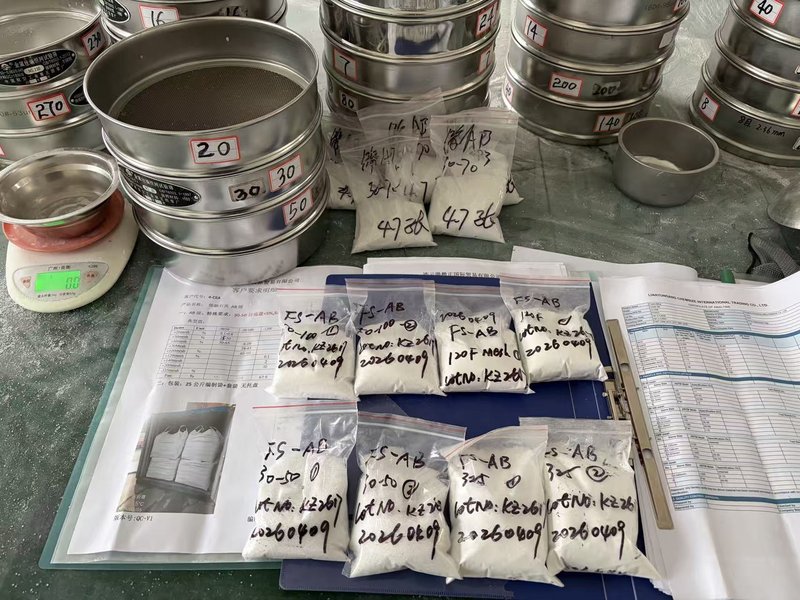
So on this order, as on multi-container orders generally, the sampling was done per container. Each container's material was sampled from identified bags, labelled with the product, particle size, lot number and sampling date, and checked against the customer's requirements before that container was loaded. A container did not get loaded on the strength of its neighbour's paperwork.
What was checked before each container was loaded
The checks follow the customer's requirements for that order. Broadly, they cover that the material in the container matches the ordered particle size, that packaging matches what was agreed, that quantities match the packing plan, and that the material and bags are clean and correctly marked. The sequence is the same every time: the checks are finished before loading starts, not alongside it.
One deliberate boundary on what we report: the pre-loading checks confirm that the material matches what was agreed for that order. They are not a fresh laboratory analysis of every bag, and this article does not restate chemical or particle-size figures from the paperwork — those belong on the COA that travels with each lot, reported against the guaranteed values for the grade.
Different packaging, same loading discipline
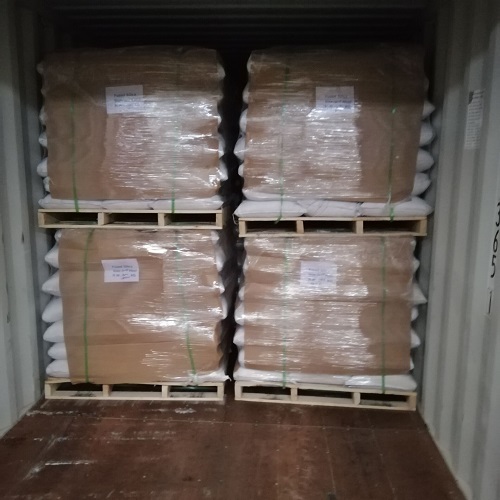
The three containers did not load the same way, because the packaging differed — 25 kg bags, jumbo bags and palletized jumbo bags each need a different loading pattern. The goal is common to all of them: a stable load that does not shift at sea, and bags that arrive without damage.
Loading is where a well-checked material can still be sent out badly. A container loaded loose to save an hour can arrive with shifted, scuffed or split packaging — and then the argument is no longer about the material, it is about who pays for the mess. So the loading plan follows the packaging type agreed for each order, and the loading itself is photographed throughout.
Photographs as part of the paperwork
The loading of each container is recorded with photographs: packaging condition before departure, how the load was built up, and the sealed result. For several customers these photos have become a routine part of the order documentation — they confirm what was loaded and how, without anyone having to take anyone's word for it.
The practical use is simple. When the documents and the photos arrive together, your incoming inspection starts from an agreed picture of what left the factory. That shortens every later conversation — with us, with the forwarder, with an insurance surveyor if it ever comes to that.
Consistency over speed
The three containers were completed over two days on this order — that was the actual result of this particular shipment, not a standing promise about every future order. What the two days actually reflect is sequence: production batches released only after their checks, sampling done per container, loading done to the packaging plan, and the photo record kept up as each container closed.
That is the part we would ask a buyer to take from this article. Whether an order is one container or several, the value is not in how fast the containers are filled. It is in knowing that the material in each container was checked on its own, and that you can trace what arrived back to what was sampled.
What to ask for on your own multi-container order
- Ask for per-container (or per-lot) sampling — and for the lot number to appear on both the bags and the COA, so every result maps to the container it came from.
- Ask for the loading photos as part of the document set if incoming inspection or an insurance claim might ever need them.
- State the packaging format at enquiry stage — 25 kg bags, jumbo bags, palletized or not — so the loading plan matches what your warehouse expects.
- If a third-party report on the specific lot is required, say so when you enquire, so it can be written into the order rather than discussed after loading.
Planning a multi-container order of fused silica sand or powder?
Send us your particle sizes, packaging format and volume, and we will confirm the checking and sampling procedure for each container, what appears on the COA, and what documentation you receive with the shipment.
Discuss Your Order