Fine powder is where a fused silica order most often goes quietly wrong. Two suppliers can both call a material "325 mesh", both ship white powder, and still deliver material that behaves differently in your mixer: one carries a few hundred ppm more alumina, the other holds a coarse tail your receiving screen never catches. Neither difference is visible on the pallet. Both show up later — as a castable that suddenly needs more water, or as a shell-room complaint three weeks after the container arrived.
This update covers the two checks that were run before this 60-ton lot of 325 mesh fused silica powder was released for loading: what each instrument measures, what it cannot measure, and how to ask for the same evidence on your own orders.
What was in this shipment?
The lot was 60 MT of 325 mesh fused silica flour, destined for a refractory customer. The nominal 325 mesh sieve opening is around 45 µm (ASTM E11), which puts the material firmly in flour territory rather than sand territory.
At 60 MT, this is a full-order quantity, not a sample. That matters for one practical reason: if a powder lot is wrong, you usually find out after it has been unloaded and partly consumed. Re-working 60 MT is not a phone call, it is a project. The two checks below are cheap relative to that.
| Volume released | 60 MT |
|---|---|
| Product | Fused silica flour, 325 mesh |
| Nominal sieve opening | around 45 µm (325 mesh, ASTM E11) |
| Trace impurity check | ICP, PerkinElmer |
| Particle-size check | Laser diffraction, Malvern |
| Customer type | Refractory producer |
| Documentation | Certificate of Analysis issued for the lot |
Why powder is checked differently from sand
With sand and grains, the things that go wrong are usually visible or mechanical: black specks, off-size particles, moisture, broken bags. With flour, the two variables that move between batches of the same nominal grade are chemistry and particle-size distribution — and neither is visible.
Chemistry moves first because surface area is unforgiving. The finer you grind, the more surface you create, and any impurity carried on or near that surface becomes a larger share of what the customer actually receives. Iron, alkalis and alkaline earths are the numbers refractory and casting buyers watch, because even at ppm levels they influence high-temperature behaviour rather than appearance.
Particle size moves for a different reason: two mills can hit the same nominal mesh and still produce different distributions, and the coarse tail is what changes how a mix flows. Fused silica is chosen in these applications partly for its very low thermal expansion (about 0.5 × 10⁻⁶/K), but that property does not help you if the powder will not disperse the way your formulation expects.
What the ICP trace-impurity analysis tells you
ICP (inductively coupled plasma) analysis reports individual elements at ppm level. For fused silica that normally means iron, aluminium, titanium, calcium, magnesium, sodium and potassium — usually reported as oxides such as Fe2O3 and Al2O3 on the COA.
This is the check that tells you whether the melt and the handling behind this lot stayed clean. It is also the number that should be read as a trend, not as a pass/fail flag: a grade is defined by a guaranteed maximum, and each lot is reported against that maximum on its own COA.
One more thing matters as much as the instrument: the sample has to belong to the lot. Samples for this kind of check are drawn from identified source bags and labelled with product, particle size, lot number and sampling date, so the result can be traced back to the material that was actually loaded — rather than treating 60 MT as one anonymous batch.
What the laser particle-size analysis tells you
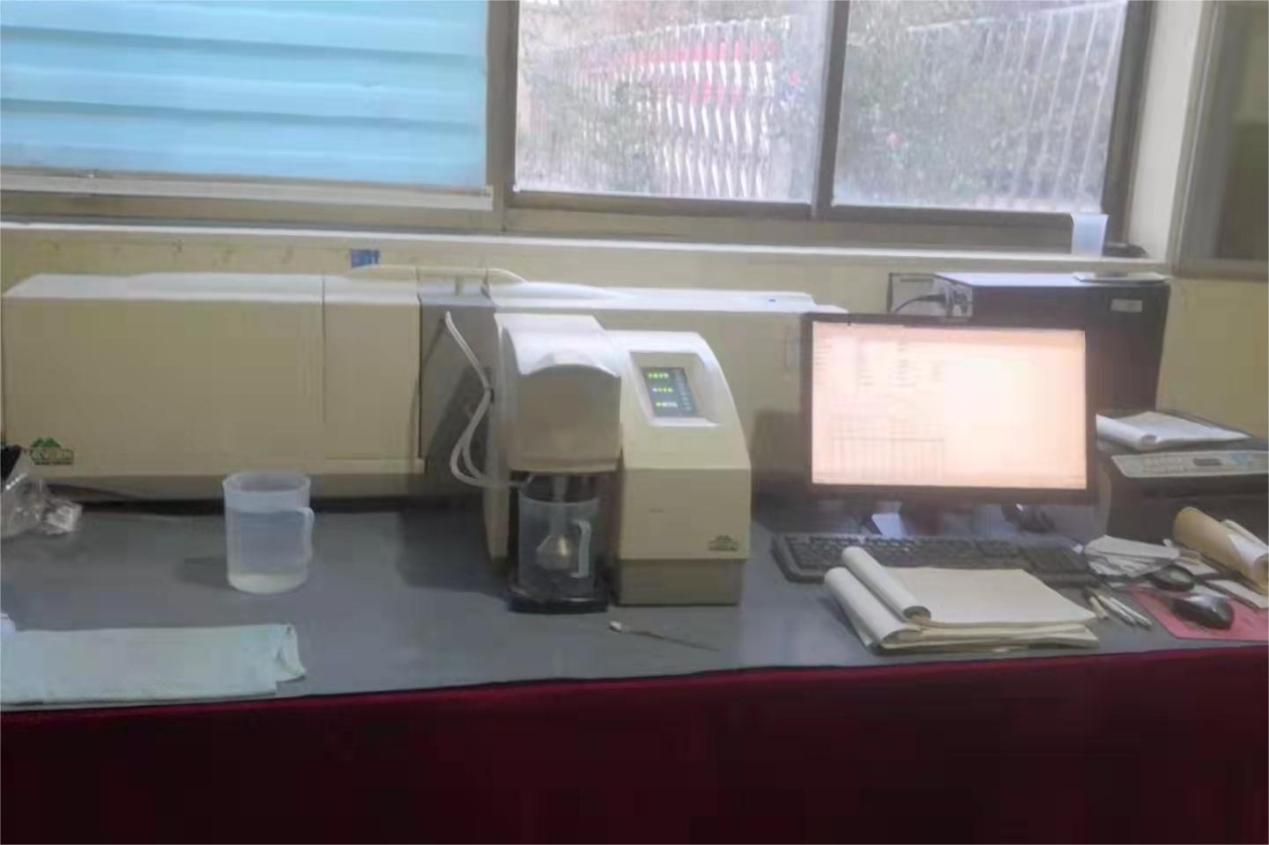
Laser diffraction reports a full distribution as D10, D50 and D90 on a volume basis. That is more information than a single "325 mesh" claim, and it is the number that predicts how the powder will behave in your mix.
Here is the trap worth knowing about, because it causes most cross-supplier arguments:
- "325 mesh" is a sieve opening, not a D50. It tells you the nominal aperture (around 45 µm), not where the midpoint of the distribution sits.
- Laser results and sieve results are not interchangeable. Sieving reports what passed or was retained; laser diffraction reports an equivalent-sphere volume distribution. The two can disagree on the same powder and both be correct.
- The method has to be stated. Wet or dry dispersion, and the optical settings used, change the reported result.
The practical consequence is simple. If you intend to accept a shipment on laser-diffraction numbers, ask for laser-diffraction numbers on the COA. Buying on one method and receiving on another is how two honest parties end up arguing about the same bag of powder.
What documentation comes with a lot like this
| Document | What it gives you |
|---|---|
| COA (with each lot) | Lot number, particle size, and the chemical items agreed for that order, reported against the guaranteed values |
| Representative SGS report | Third-party testing on representative samples, including crystalline phase data by XRD — not issued for every shipment |
| Packing and marking | Bag identification and lot marking so a delivered bag can be tied back to its COA |
Being explicit about this avoids a misunderstanding we would rather not have: a COA travels with each lot, while third-party SGS reports are representative and are not issued per shipment. If your incoming inspection needs a third-party report on a specific lot, say so when you enquire and it can be written into the order.
How to specify this on your own order
Four lines on an enquiry save the most trouble later:
- State how particle size will be judged — nominal mesh plus sieve residue, or laser-diffraction D50 / D90 limits. Pick one and ask the COA to report it the same way.
- State impurity limits with the method and unit — for example Fe2O3 in ppm by ICP. "Low iron" is not a specification; a number with a method is.
- Ask for lot traceability — lot number on the bag and on the COA, so a result can be tied to a specific delivery.
- Run a small first lot if the material is going into a fixed formulation. One container tells you more than any datasheet.
And if crystalline phase content, loss on ignition, or magnetic content matter to your process, name them at enquiry stage. They are all testable — they just are not part of a default powder release.
Is this a standing promise?
No. The checks described here are the ones carried out for this shipment, and they are reported because they were done — not as a blanket commitment attached to every order.
Which tests accompany your order depends on what is agreed in the quotation. That is the point of the section above: decide what you need tested, ask for it in writing, and it goes on the order. Anything not written down is, in practice, not specified.
Ordering 200 or 325 mesh fused silica powder?
Chemsize supplies fused silica flour and powder in standard and customised particle-size distributions. Send us your specification, the test method you will accept on, your quantity and your target loading date, and we will confirm what is achievable and what will be reported on the COA.
Send Your Specification